
There are numerous reasons why a lady, or in quote “a female gender,” cannot become pregnant, ranging from natural factors to behavioral factors such as “Endometriosis”
Endometriosis is a disease in which tissue similar to the lining of the uterus grows outside the uterus. It can cause severe pain in the pelvis and make it harder to get pregnant.
One fact remains that, “Endometriosis” doesn’t have known cause, and can last from the first day of menstruation till menopause.
Endometriosis causes tissue that resembles uterine lining to proliferate outside of the uterus. This causes the pelvic area and, in rare cases, other parts of the body to become inflamed and to form scar tissue.
There is no clear cause for endometriosis. There is no known way to prevent endometriosis. While there is not a known cure, the symptoms can be managed with medication and, in some cases, surgery.
Several lesion TYPES have been described , which include:
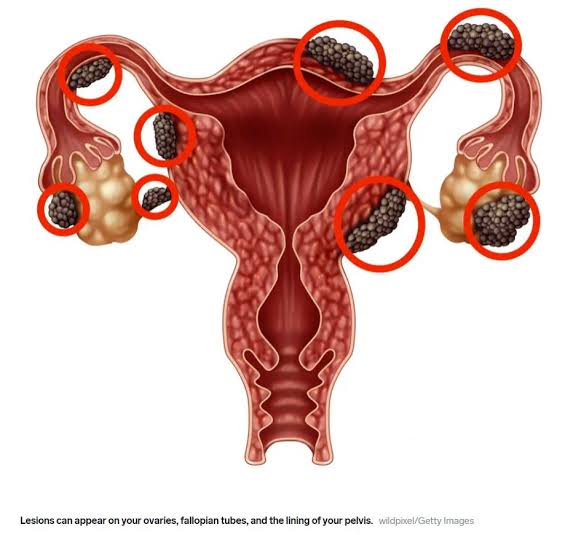
- Superficial endometriosis: found mainly on the pelvic peritoneum
- cystic ovarian endometriosis (endometrioma): found in the ovaries
- deep endometriosis: found in the recto-vaginal septum, bladder, and bowel
- in rare cases, endometriosis has also been found outside the pelvis.
SYMPTOMS
The symptoms of Endometriosis are variables and are broad, which means, health workers cannot diagnose it easily. The symptoms include the following :
Many people with “Endometriosis” don’t show or have any symptoms. But for those who do, a common symptom is pain the lower belly (pelvis) which may be most noticeable:
- During a period
- During or after sex
- When urinating or defecating
Some people also experience :
- Bloating or nausea
- Fatigue
- Having heavy bleeding during a period or between periods
- Depression or anxiety
- Chronic pelvic pain
CAUSES
Regardless of their social standing or ethnic background, endometriosis is a complicated illness that affects a large number of women worldwide from the time of their menarche until menopause. Its development is thought to be influenced by a wide range of factors. Currently, endometriosis is believed to develop as a result of:
- Retrograde menstruation is when menstrual blood containing endometrial cells flows back through the fallopian tubes and into the pelvic cavity at the time that blood is flowing out of the body through the cervix and vagina during periods. Retrograde menstruation can result in endometrial-like cells being deposited outside the uterus where they can implant and grow.
- Cellular metaplasia is when cells change from one form to another. Cells outside the uterus change into endometrial-like cells and start to grow.
- Stem cells can give rise to the disease, which then spreads through the body via blood and lymphatic vessels.
The development or survival of ectopic endometrial tissue may also be influenced by additional variables. For instance, it is well known that endometriosis is estrogen-dependent, and that this increases the disease’s growth, inflammation, and pain. However, the relationship between estrogen and endometriosis is complex since the absence of estrogen does not always mean the absence of endometriosis.
TREATMENT
Treatments to manage endometriosis can vary based on the severity of symptoms and whether pregnancy is desired. No treatments cure the disease.
A range of medications can help manage endometriosis and its symptoms.
Non-steroidal anti-inflammatory drugs (NSAIDs) and analgesics (painkillers) like ibuprofen and naproxen are often used to treat pain.
Hormonal medicines like GnRH-analogues and contraceptive (birth control) methods can also help control pain. These methods include:
- pills
- hormonal intrauterine devices (IUDs)
- vaginal rings
- implants
- injections
- patches.
These methods may not be suitable for those wanting to get pregnant.
Fertility medicines and procedures are sometimes used for those having difficulty getting pregnant because of endometriosis.
Surgery is sometimes used to remove endometriosis lesions, adhesions and scar tissues. Laparoscopic surgery (using a small camera to visualize inside the body) allows doctors to keep incisions small.
Discuss your treatment options with a health care provider.
Treatments are based on individual preferences and effectiveness, side effects, long-term safety, costs and availability.
Always understand your body system so that you can know when something is wrong or right.
ALL ABOUT HEALTH…
References: WHO https://www.who.int/news-room/fact-sheets/detail/endometriosis.
Adewara Emmanuel Nifemi: https://allabouthealths.health.blog/



 ALL ABOUT HEALTH (AAH)
Leave a comment